In recent years, agentic systems have become a common way to decompose complex problems across autonomous components.
As autonomy increases, however, a familiar issue re-emerges: observability becomes harder precisely when it becomes more necessary.
Most existing observability approaches—logging, metrics, tracing—were not designed with agentic dynamics in mind.
When applied to multi-agent systems, they often introduce subtle but dangerous side effects: implicit coordination, feedback loops, and semantic coupling between components that were meant to remain independent.
This post documents an architectural stance we have been exploring internally at Enkronos:
how to observe agentic systems without influencing them.
The observability paradox in agentic systems
In traditional software, observability is usually considered neutral.
Logs and metrics are assumed to describe behavior, not shape it.
In agentic systems, this assumption breaks down.
Even minimal shared signals can lead to:
- unintended coordination between agents
- feedback amplification over time
- emergent strategies that were never explicitly designed
- loss of isolation between autonomous components
Ironically, observability layers often become control layers by accident.
Dashboards invite intervention, metrics invite optimization, logs invite tuning.
In regulated or safety-critical environments, this creates a paradox:
systems must be observable, but observation itself becomes a source of risk.
Observation is not neutral by default
One conclusion emerged early in our work:
In agentic systems, observation is never neutral unless explicitly designed to be so.
This insight led us to design a constrained observability architecture that treats limits as a feature, not a drawback.
We call this architecture AIEL.
AIEL in one sentence
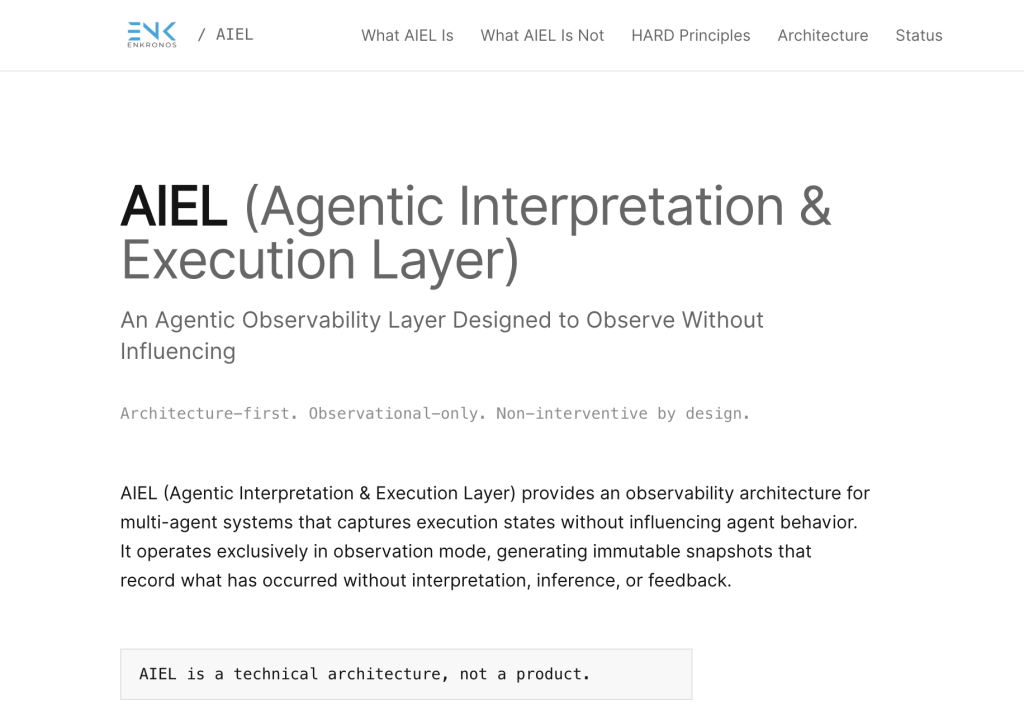
AIEL (Agentic Interpretation & Execution Layer) is an architecture-first observability layer designed to observe agentic systems ex-post, without introducing coordination, feedback, or interpretation.
It is not a product.
It is not a framework.
It is not an orchestration layer.
It is an architectural position.
What AIEL deliberately refuses to do
AIEL is defined as much by what it does not do as by what it does.
It is not:
- an agent orchestrator
- a decision engine
- a planner or policy layer
- a ranking or scoring system
- a shared memory or knowledge graph
- a feedback or optimization mechanism
If a system can influence agent behavior—directly or indirectly—it is not AIEL.
This negative definition is not defensive.
It is foundational.
Designing around constraints: the HARD principles
AIEL is governed by a small set of non-negotiable design constraints, internally referred to as the HARD principles:
- No agent-to-agent communication
- No feedback loops
- Observational-only behavior
- Temporal boundedness of all signals
- No emergent or semantic inference
These are not guidelines.
They are architectural invariants.
If a design violates one of them, it is considered out of scope by definition.
Signals, not messages
One concrete consequence of these constraints is how agents interact with the observability layer.
Agents in AIEL do not communicate.
They emit signals, not messages.
Each signal is:
- typed
- schema-validated
- time-limited
- write-only from the agent’s perspective
Signals cannot be read or consumed by other agents.
They cannot become coordination primitives.
This ensures that observability does not turn into signaling.
Snapshots instead of insights
At the observability level, AIEL produces snapshots, not interpretations.
Snapshots may include:
- counts of active signals
- distributions by signal type
- distributions by remaining lifetime
They never include:
- payload semantics
- agent identities
- ordering with meaning
A snapshot is a photograph, not a diagnosis.
Auditability without intervention
AIEL also supports explicit, ex-post audit generation.
Audits are:
- triggered manually
- immutable once produced
- side-effect free
- designed for human or tool-based review
Each audit can be accompanied by a short, human-readable report explicitly stating:
This audit does not imply correlation, causality, or inference.
Audits exist to document what happened—not to explain why.
Choosing bounded usefulness over intelligence
Most systems attempt to extract value through interpretation.
AIEL deliberately avoids this path.
Interpretation introduces responsibility, bias, incentives to optimize, and implicit control.
In some contexts, that trade-off may be acceptable. In others, it is not.
AIEL chooses bounded usefulness over unbounded intelligence.
It is intentionally less capable than it could be.
This is not a limitation to be overcome, but a design choice to be preserved.
Why publish this now
We decided to document AIEL publicly not as a launch, but as a disclosure.
The architecture is:
- implemented
- tested
- and deliberately frozen in scope
There is no roadmap announcement, no product positioning, and no call to adoption.
Sometimes, writing an architecture down publicly is simply the most honest thing to do.
Further reading
- AIEL White Paper (PDF):
An Agentic Observability Layer Designed to Observe Without Influencing - AIEL public site:
https://aiel.enkronos.com
This post is part of Enkronos’ ongoing research into safe, constrained, and auditable agentic systems.