A formally published metabolic governance engine for bounded execution in agentic infrastructures.
Artificial intelligence has moved from assistance to execution.
Agents are no longer prompts. They are execution units — operating with cost, autonomy, escalation paths, and real-world impact.
As organizations scale autonomous agents, a structural problem emerges:
Execution expands faster than control.
Retries amplify.
Costs drift.
Policies fragment.
Accountability weakens.
Most orchestration frameworks optimize performance.
Few enforce bounded governance.
This is where LungClaw begins.
The Structural Problem of Agentic Execution
Autonomous systems introduce non-linear behavior:
- Task decomposition increases execution branching.
- Retry mechanisms amplify cost unpredictably.
- Cross-agent escalation creates hidden risk surfaces.
- Audit complexity grows exponentially with scale.
Without deterministic containment, autonomy becomes volatility.
The issue is not intelligence.
The issue is bounded control.
Introducing LungClaw
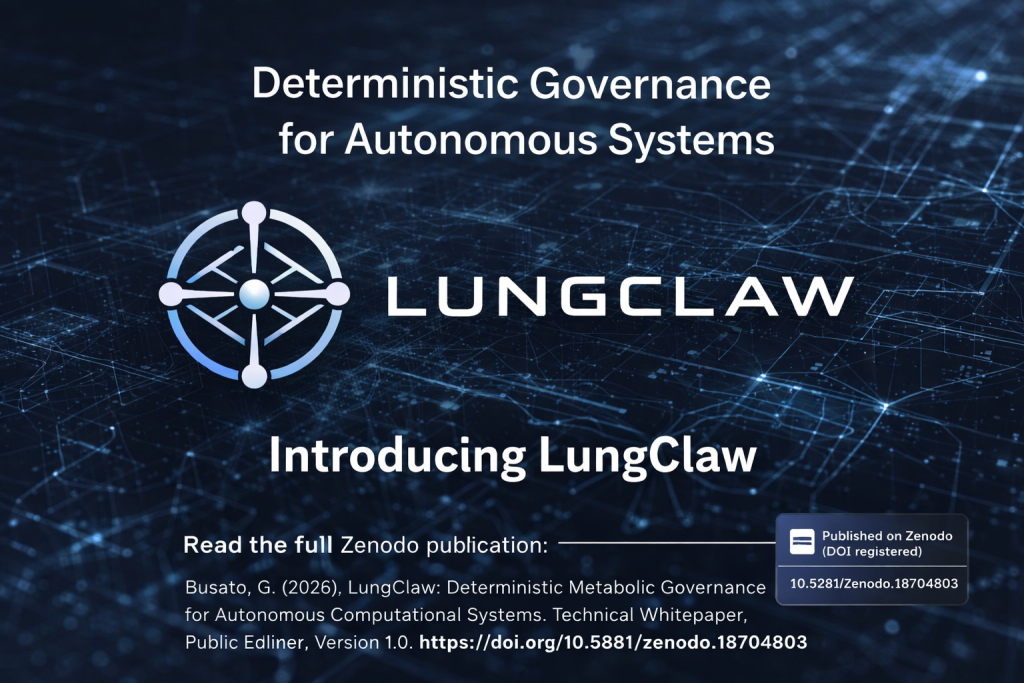
LungClaw is a deterministic metabolic governance engine designed to enforce execution containment in autonomous agentic systems.
It introduces a constraint-based governance model built around:
- Energy-based execution bounding
- Deterministic transition validation
- Atomic commit semantics
- Non-adaptive policy containment
- Monotonic constraint evaluation
Instead of reacting to failures, LungClaw prevents structural instability.
It does not orchestrate agents.
It governs them.
Formal Model
LungClaw evaluates each transition through a constraint equation:
Γ = ExpectedReturn − EstimatedCost
u = k · max(0, E_critical − E)
allowed ⇔ (Γ − u ≥ 0)
Where:
- Γ represents projected execution viability
- u represents constraint pressure
- allowed enforces bounded decision propagation
No adaptive gain.
No retry amplification.
No cross-agent cost leakage.
Determinism is preserved at every evaluation boundary.
Formal Guarantees
The LungClaw model enforces:
- No unbounded execution loops
- No hidden cross-agent escalation
- Atomic energy commits
- Deterministic evaluation order
- Fail-safe interruption semantics
- Governance isolation across holdings
This creates what we call:
Non-collapsing agentic runtime architecture.
Publication & DOI
The full technical specification is publicly archived:
Busato, G. (2026).
LungClaw: Deterministic Metabolic Governance for Autonomous Computational Systems.
Version 1.0. Zenodo.
DOI: https://doi.org/10.5281/zenodo.18704803
The whitepaper includes formal invariants, architectural constraints, non-goals, and boundary conditions.
LungClaw is not a framework.
It is a constraint engine.
Why This Matters Now
The current wave of agentic systems is accelerating rapidly.
Hype focuses on capability.
Few focus on containment.
As execution authority scales, governance must scale with equal rigor.
Without deterministic boundaries, agentic infrastructure accumulates hidden cost and structural instability.
With LungClaw, containment becomes architectural.
What Comes Next
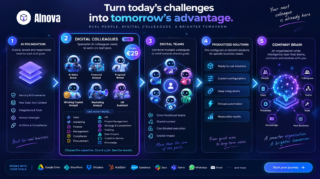
LungClaw is deployed as the deterministic governance engine underlying AINOVA — the operational control layer for autonomous AI.
But the engine stands independently.
Governance should be formal.
Bounded.
Auditable.
Deterministic.
The age of autonomy requires nothing less.
- Read the full whitepaper: https://zenodo.org/records/18704803
- Read more on LungClaw: https://lungclaw.com/
- Explore the governance layer powered by LungClaw: https://ainova.io
Enkronos Team