Last month, an autonomous agent inside a mid-size fintech retried a failed reconciliation task 47 times before a human noticed. Total damage: $23,000 in wasted compute, a compliance flag, and an entire weekend of incident response.
No one had scoped its retry limits. No one had bound its cost ceiling. No one had enforced a containment policy.
The agent was doing exactly what it was designed to do — execute. The problem was that no one had designed the boundary around it.
This is not an edge case. It is the default outcome when execution scales faster than control.

The Exposure You’re Not Measuring
Before we talk about the product, let’s talk about numbers.
Using our Governance Risk & Cost Exposure model, we simulated a typical AI-native environment: 10 active autonomous agents, $500 average monthly runtime cost per agent, 1,000 monthly tasks per agent, $5,000 average incident resolution cost, and 30% of actions requiring audit.
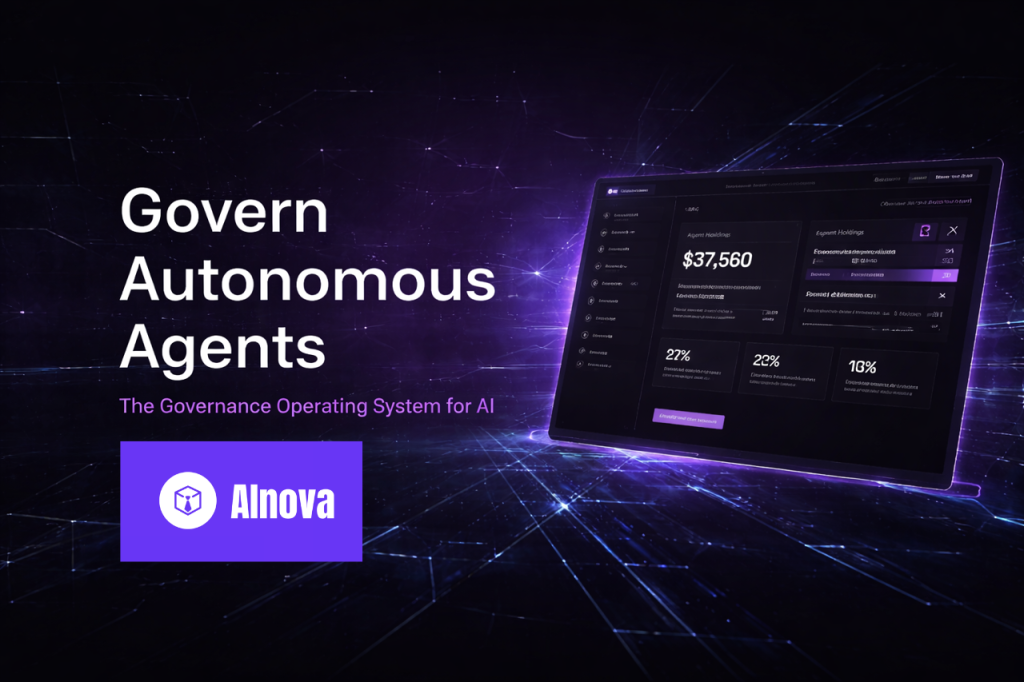
Estimated annual governance exposure: $37,560.
Projected mitigation through deterministic containment: $13,146 per year.
And this is a conservative model. As agent count increases, variance and escalation risk compound non-linearly — not because agents fail more often, but because uncontained failure propagates faster.
Before deploying any governance layer, quantify your current exposure: ? https://ainova.io/governance-exposure

Why This Problem Exists
Organizations are deploying autonomous agents across operations, finance, infrastructure automation, customer workflows, and internal decision systems. The industry has invested heavily in model capability, orchestration frameworks, and tool integrations.
But almost no one has built a control layer that enforces identity-bound authority, policy-scoped execution, deterministic transition validation, cross-agent containment, and audit visibility at runtime.
The result: autonomy without governance accumulates hidden exposure. Every unscoped agent is a liability that compounds silently.
What AINOVA Is
AINOVA is the governance operating system for autonomous AI.
It allows organizations to register existing agents, bind them to holdings and scoped roles, enforce deterministic execution policies, monitor runtime behavior, audit state transitions, and contain operational exposure.
AINOVA does not replace your agents. It governs them.
In practice, this means every agent action is bounded by predefined cost and behavior limits — no exceptions, no drift. If an agent exceeds its scope, the system doesn’t warn you after the fact. It prevents the violation from executing.
This is not orchestration. It is structural containment.
Built on Published Research
AINOVA is powered by LungClaw, a deterministic metabolic governance engine we formally published and registered with Zenodo (DOI: https://doi.org/10.5281/zenodo.18704803).
The LungClaw whitepaper defines the formal foundations: energy-based execution bounding, deterministic evaluation semantics, atomic commit guarantees, non-adaptive constraint enforcement, and runtime containment invariants.
In plain terms: LungClaw provides the mathematical guarantee that governance rules are enforced deterministically — not probabilistically, not heuristically. Every state transition is validated against a finite, auditable constraint set before it commits.
AINOVA takes that engine and deploys it operationally. Research provides the invariants. AINOVA enforces them in production.
Who We Built This For
AINOVA is built for AI-native founders scaling agent-based products, infrastructure teams deploying autonomous workflows, organizations running multi-agent execution environments, and high-spend AI operators seeking cost containment and accountability.
If you are running agents in production, governance is no longer optional. It is the difference between scaling with confidence and scaling into exposure.
Why Us
We built AINOVA because we saw the same pattern repeating across every organization deploying autonomous agents: brilliant execution, fragile control. Teams shipping agents with no identity binding, no cost ceilings, no audit trail, and no containment policy.
We published the research first — not as a marketing exercise, but because we believe governance for autonomous systems needs to be grounded in formal, verifiable foundations, not in best-effort middleware.
The LungClaw paper is peer-reviewable, DOI-registered, and open. The product is built directly on top of it.
Available Now
AINOVA is live. You can register your agents, apply governance policies, monitor execution, quantify exposure, and upgrade governance tiers — starting today.
- Explore AINOVA: https://ainova.io
- Model your governance exposure: https://ainova.io/governance-exposure
Every day without a governance layer is a day your agents accumulate untracked exposure. Start with the free assessment.
Enkronos – AInova Team